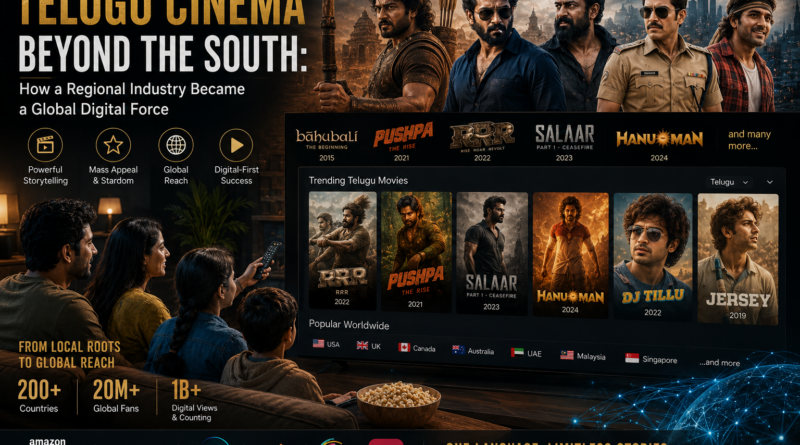
How a Regional Industry Became a Global Digital Force
Telugu cinema has developed into one of India’s most influential regional film industries, with a large domestic audience and an increasingly visible international presence. Its digital growth has made this cinematic world easier to access across geographical boundaries, while the expansion of streaming has changed how viewers discover films in different languages. For audiences interested in তেলেগু মুভি অনলাইন, online access provides a convenient way to explore Telugu-language entertainment through a flexible catalog rather than relying exclusively on local theaters, television schedules, or physical media.
The Telugu Screen Has Become a Global Window
Telugu cinema has long had a strong audience in Andhra Pradesh and Telangana, but its reach now extends substantially beyond those markets. Telugu-speaking communities across the Gulf, North America, Southeast Asia, Europe, and other regions have helped maintain demand for regional-language entertainment abroad.
The international visibility of Telugu filmmaking has also grown through digital platforms. Streaming allows audiences outside India’s traditional Telugu-speaking markets to encounter films that may have limited theatrical distribution in their countries. The result is a more direct relationship between regional filmmaking and international viewers.
This expansion is part of a broader transformation in Indian entertainment. Regional-language cinema is no longer necessarily treated as a secondary category within the country’s digital ecosystem. Telugu, Tamil, Bengali, Malayalam, Marathi, and other languages increasingly have dedicated audiences and distinct streaming identities.
For viewers, that means geographic location is becoming less important to the discovery process. An internet connection and a suitable device can provide access to a Telugu catalog even when local television or cinema programming offers little regional content.
From Tollywood to a Wider Telugu Film Culture
The term Tollywood is often used to describe the Telugu film industry, particularly the production centers associated with Hyderabad. Yet the culture surrounding Telugu cinema extends beyond a simple industry label.
The catalog includes mainstream commercial entertainment as well as comedy, romance, drama, crime, thriller, family cinema, historical subjects, fantasy, social themes, and more experimental productions. Different generations have contributed to an industry that continues to adapt its production methods and relationship with audiences.
This diversity is particularly useful in a digital environment because viewers can approach Telugu cinema from many different directions. A viewer looking for action can remain within that category, while another can explore comedy, drama, romance, or suspense.
A strong catalog makes these distinctions visible. Instead of presenting a large number of titles as one continuous stream, organized shelves and intuitive categories help audiences understand the breadth of available Telugu entertainment.
A Language With a Powerful Digital Audience
The growth of Telugu-language content is closely connected with India’s wider shift toward regional-language digital consumption. Internet users increasingly consume entertainment in languages other than English, while smartphones and affordable mobile data have made regional content easier to distribute.
This trend is particularly relevant to Telugu cinema because language remains an important part of the cultural experience. Dialogue, humor, music, social references, and everyday expressions are closely connected with Telugu identity.
Digital distribution can preserve that linguistic character while extending the audience beyond the language’s traditional geographic boundaries. Subtitles and multilingual interfaces can also help non-Telugu speakers explore the category without requiring the original language to be replaced.
This combination of authenticity and accessibility is one of the strongest advantages of online regional cinema. The film remains Telugu, while the method of reaching the audience becomes international.
Why Telugu Cinema Works So Well Online
The digital format is particularly well suited to a large and varied regional film catalog. Traditional television schedules provide limited space, while physical collections depend on availability and ownership. An online catalog can present a much wider selection and allow viewers to determine what interests them.
This changes the rhythm of movie discovery. Instead of waiting for a Telugu film to appear on television, audiences can browse the catalog when convenient. They can explore genres, search for specific titles, or simply move through the available shelves until something catches their attention.
The same flexibility is useful for international audiences. A viewer living outside India may have no practical access to Telugu-language television, but an online catalog can provide a direct alternative.
The experience is strongest when discovery and playback are closely connected. Once viewers find a title that interests them, they should be able to move toward watching without unnecessary administrative steps.
A Digital Shelf Built for Easy Discovery
The organization of a streaming catalog can determine how enjoyable browsing feels. Telugu cinema has accumulated a substantial number of productions across different periods, making simple presentation insufficient for a modern audience.
Genre categories can provide an immediate starting point, while curated collections can introduce viewers to related titles. Search functionality serves audiences who already know what they want, and sections devoted to newer additions can help those interested in contemporary releases.
This structure also supports discovery beyond familiar choices. A viewer may enter the catalog looking for one genre and notice another category that appears interesting. Digital shelves make these connections visible in a way that fixed television schedules cannot.
Moviewala’s frictionless catalog experience keeps the journey from discovery to playback short. Viewers can browse the Telugu selection, select a title directly from the shelf, and move toward watching without a mandatory registration wall. The absence of annoying pop-ups also prevents unnecessary interruptions during browsing.
The Changing Relationship Between Cinema and Streaming
Theatrical cinema remains important to Telugu audiences, but streaming has introduced another stage in the distribution cycle. Films can reach theaters first and later become part of digital catalogs, allowing audiences who missed the theatrical window to discover them at home.
This model has become increasingly important throughout India’s entertainment industry. Streaming rights have developed into a significant part of film distribution, while audiences have become accustomed to moving between theatrical and digital viewing.
For Telugu cinema, the model is especially useful because the international audience is geographically dispersed. A theatrical release may have strong availability in Hyderabad but limited access in London, Dubai, Singapore, or Toronto. Digital distribution can help close some of that gap.
The result is not necessarily a competition between theaters and streaming. Instead, they increasingly represent different stages and environments within the same broader entertainment ecosystem.
Telugu Movies on Large and Small Screens
The modern viewer can access Telugu cinema through a growing variety of devices. Smart TVs provide a natural environment for home viewing, while laptops and desktop computers offer flexible personal access. Tablets and smartphones make the catalog available in more portable situations.
This multi-screen environment is particularly valuable for audiences living outside Telugu-speaking regions. A viewer can access regional cinema from whichever device is most convenient without maintaining a physical collection.
For streaming platforms, however, device diversity requires careful interface design. A catalog that works well on a large television should remain practical on a smartphone. Shelves, menus, search tools, and playback controls need to adapt naturally to different display sizes.
The best experience feels consistent across devices. The viewer can change the screen without having to change the way they understand the catalog.
The Invisible Infrastructure Behind Telugu Streaming
High-quality online cinema depends on sophisticated technology that remains mostly invisible to the audience. Cloud infrastructure, content delivery networks, video compression, and adaptive streaming systems work together to deliver large audiovisual files efficiently.
Compression helps reduce the amount of data needed to transmit detailed video, while adaptive bitrate technology can respond to changing network conditions. Distributed delivery infrastructure can improve responsiveness for viewers connecting from different geographical locations.
These systems are particularly important when Telugu cinema is being watched internationally. A viewer in India may have a completely different connection from someone accessing the same catalog in the Middle East or North America.
The platform therefore needs to handle these differences in the background. The viewer should simply be able to select a movie and experience stable, high-quality playback without having to manage technical settings.
Telugu Cinema and the International Streaming Economy
The growing international presence of Telugu entertainment reflects a larger shift in the global perception of Indian regional cinema. Audiences increasingly explore Indian films beyond Hindi-language Bollywood, creating more space for South Indian industries to establish their own identities internationally.
Streaming has accelerated this process because digital catalogs are not limited by the same geographic constraints as traditional theatrical distribution. A successful regional production can become visible to audiences in countries where it might otherwise have had little commercial exposure.
This creates an important opportunity for Telugu cinema. Its language and cultural identity remain central, but digital distribution allows that identity to travel further.
For international viewers, Telugu cinema can therefore become part of a broader exploration of Indian filmmaking. Moving between Telugu, Tamil, Bengali, Hindi, Malayalam, and other language categories becomes increasingly natural within a modern streaming environment.
What Makes a Premium Online Telugu Experience
The size of a catalog matters, but usability determines whether audiences can actually enjoy that selection. A platform can offer many Telugu films, yet complicated navigation or excessive registration requirements can make discovery unnecessarily difficult.
A premium experience should reduce those obstacles. Viewers should be able to enter the catalog, browse categories, select a movie, and begin playback without being forced through multiple administrative screens.
This is where direct one-click access becomes valuable. It allows the digital shelf to function as the central point of interaction, keeping the distance between choosing and watching as short as possible.
An uncluttered interface also matters. Without annoying pop-ups competing for attention, the viewer can concentrate on the catalog and make a decision at their own pace.
The Next Era of Telugu Cinema Online
The future of Telugu digital entertainment will likely be influenced by faster connectivity, expanding connected-TV adoption, improved mobile experiences, more efficient video compression, multilingual support, and increasingly intelligent catalog organization.
As regional-language streaming continues to grow, discovery will become as important as availability. Audiences will expect large collections to remain easy to navigate, with categories and search tools that help them find relevant entertainment without overwhelming them.
At the same time, better infrastructure will allow high-quality Telugu cinema to reach increasingly diverse international audiences. The language can remain authentic while the distribution becomes global.
The experience ultimately benefits from simplicity. Open the Moviewala Bengali catalog, explore the Telugu movie shelves, choose a title directly from the catalog, and press play. With high-quality playback, direct one-click access, no registration wall, and no distracting pop-ups, the platform can keep the technology unobtrusive while giving Telugu cinema room to speak for itself.