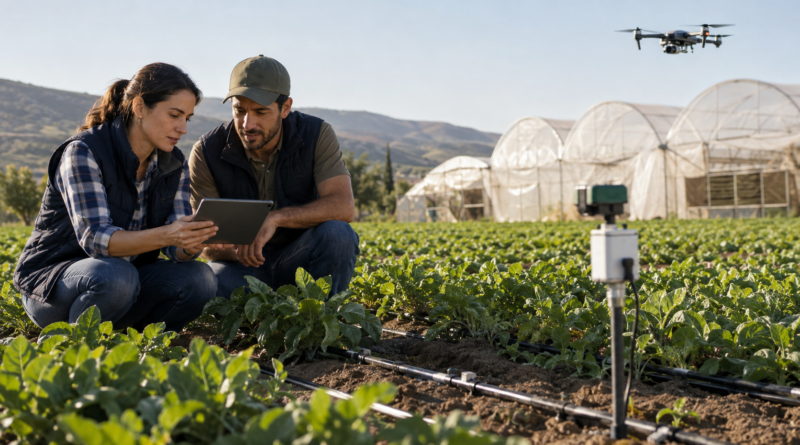
Agritech Is Helping Farms Produce More With Less Water
Water has always shaped farming decisions in Israel, but rising temperatures and unpredictable rainfall are making efficient use even more important. A new generation of agricultural technology is helping growers understand exactly what crops need, apply water at the right moment and avoid waste without sacrificing quality.
Drip irrigation remains the foundation of this approach. By delivering small amounts directly to plant roots, the system reduces evaporation and runoff compared with broad surface watering. Modern installations can divide fields into zones, allowing farmers to adjust schedules for different soils, crops and stages of growth.
Sensors add another layer of precision. Devices placed in the ground measure moisture, temperature and salinity. Instead of watering according to a fixed calendar, a grower can respond to current conditions. This matters because a field that looks dry at the surface may still contain enough moisture deeper around the roots.
Weather stations and forecasting services also improve decisions. Accurate local information about heat, wind and humidity helps farms estimate how quickly water will be lost. When heavy rain is likely, irrigation can be delayed. During extreme heat, a carefully timed cycle may protect plants from stress.
Satellite and drone images give managers a wider view. Changes in plant color can reveal weak growth, blocked irrigation lines or disease before the problem becomes obvious from the road. Inspecting only the affected area saves time, fuel, fertilizer and water.
Farm-management software brings these signals together. A single dashboard can display sensor readings, irrigation history, crop plans and cost data. The goal is not to replace the farmer’s experience. It is to make that experience more effective by showing patterns that are difficult to see during a busy season.
Protected agriculture is benefiting as well. In greenhouses, automated systems can control irrigation, shade and ventilation. Recycling drainage water, when handled safely, can further reduce demand. These methods make production more consistent and allow certain crops to grow through challenging weather.
The technology still has obstacles. Equipment can be expensive for small farms, connectivity is unreliable in some rural areas, and data requires careful interpretation. Training and affordable financing are therefore as important as the hardware itself. Systems must also be simple enough to repair locally.
Agritech works best when it solves a practical problem rather than adding complexity. A sensor that prevents one unnecessary watering cycle, or an alert that identifies a leaking pipe, can produce immediate savings. Across an entire season, many small improvements add up. Using water more precisely protects a limited resource while helping farms remain productive and economically resilient.